








South Korea, a global trendsetter in beauty, has become a top overseas destination for global cosmetics brands. An increasing number of color cosmetics and skincare brands are targeting this highly demanding, tightly regulated market.
However, exporting cosmetics to South Korea involves much more than shipping product out the door. The compliance pathway presents regulatory hurdles at every stage—from entity registration and ingredient compliance to labeling and post-market surveillance.
Core Compliance Challenges
1. Mandatory Domestic Entity: Responsible Cosmetics Distributor Registration
Under the Korean Cosmetics Act, all imported cosmetics must designate or establish a local Responsible Cosmetics Distributor. This entity carries final legal liability for product safety, quality, labeling, and advertising.
- It operates under a registration system, requiring notification/declaration to the local Food and Drug Administration.
- A full-time, non-concurrent Responsible Sales Manager with a degree or certified experience in pharmacy, chemical engineering, or biological sciences is required.
- A formal Quality Agreement with the overseas manufacturing facility should be signed
Note: Overseas enterprises must partner with a licensed South Korean entity or establish a local subsidiary to complete this registration.
2. Product Classification Determines Time-to-Market
General Cosmetics: Require filing prior to import (typically 1–2 weeks).
Functional Cosmetics: Products claiming whitening, anti-wrinkle, sunscreen, anti-hair loss, or hair dyeing/perming require pre-market review or reporting by the MFDS (takes 2–4 months).
Key Principle: Any cosmetic products with functional claims on packaging or in marketing are managed as functional cosmetics—regardless of the underlying formula. This includes base makeup featuring SPF/PA designations.
3. Stringent Ingredient Review
- Strict Control of Banned & Restricted Substances: Heavy limits apply to mercury, hydroquinone, steroids, and phenoxyethanol (≤ 1%).
- Color Additives: Limited strictly to the MFDS positive list, with mandatory impurity controls.
- UV Filters: Must appear on the approved list and adhere to individual and cumulative concentration limits.
- Nanomaterials: Require explicit declaration and labeling with “nano” in the full ingredient list.
- Fragrance Allergens: Must be individually disclosed if concentrations exceed thresholds (Leave-on products ≥ 0.001% or Rinse-off products≥ 0.01%) .
4. Labeling Requirements
- Standard Korean ICID names are mandatory. Direct Chinese translations or mixed English INCI terms are strictly prohibited.
- Listed in descending order of concentration; ingredients below 1% may be listed in any order.
- Claims such as "treatment," "repair," "regeneration," "anti-inflammatory," "sterilization," or "mite removal" are forbidden.
- Font size must generally be at least 7pt on both primary and secondary packaging.
- Labels in Korean must be applied prior to shipment; labeling within bonded warehouses requires special authorization and extra fees.
5. Documentation Integrity is a Key Focus
All regulatory submittals—including business licenses, manufacturing permits, GMP/ISO 22716 certificates, Letters of Authorization (LOA), formulation sheets, Certificates of Analysis (COA), MSDS, and Product Information Files (PIF)—must maintain absolute consistency. Discrepancies in company names or addresses, expired dates, missing stamps, or unsealed multi-page documents will cause delays or rejections.
6. Post-Market Liabilities
- Adverse Event Reporting: Mandatory tiered reporting (severe adverse events must be reported within 15 days).
- Quality Controls: Mandatory establishment of recall and Corrective and Preventive Action (CAPA) mechanisms.
- Penalties for Non-Compliance: Sales suspensions (15 days to 12 months), registration revocation, up to 3 years of imprisonment or fines up to 30 million KRW, and strict liability under Product Liability (PL) laws.
Regulatory Process
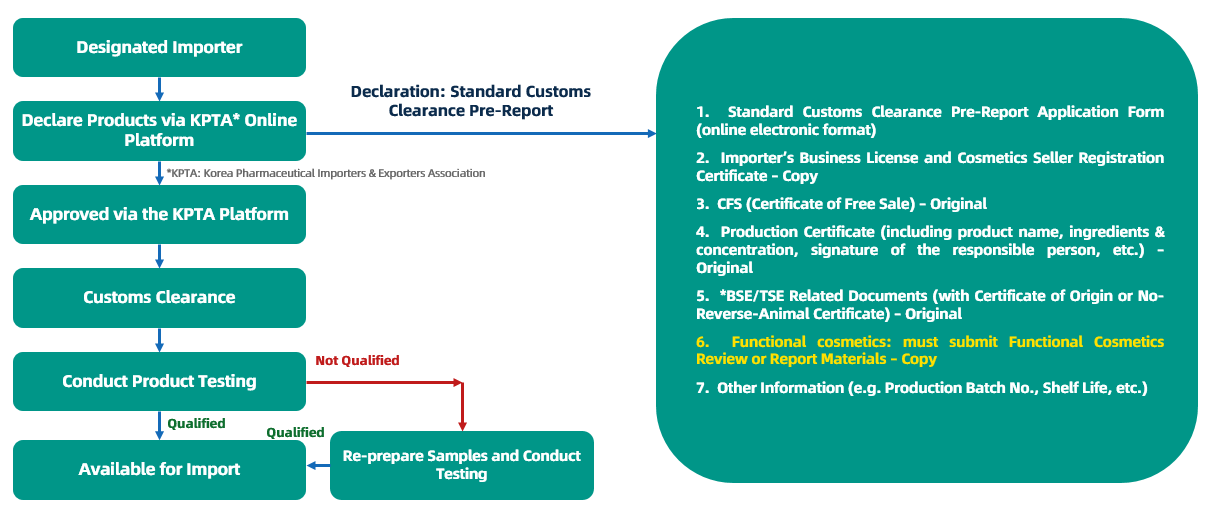
Cosmetics, both general and functional cosmetics, exporting to South Korea must undergo customs clearance, namely, the Standard Customs Clearance Pre-report. The process is as follows:
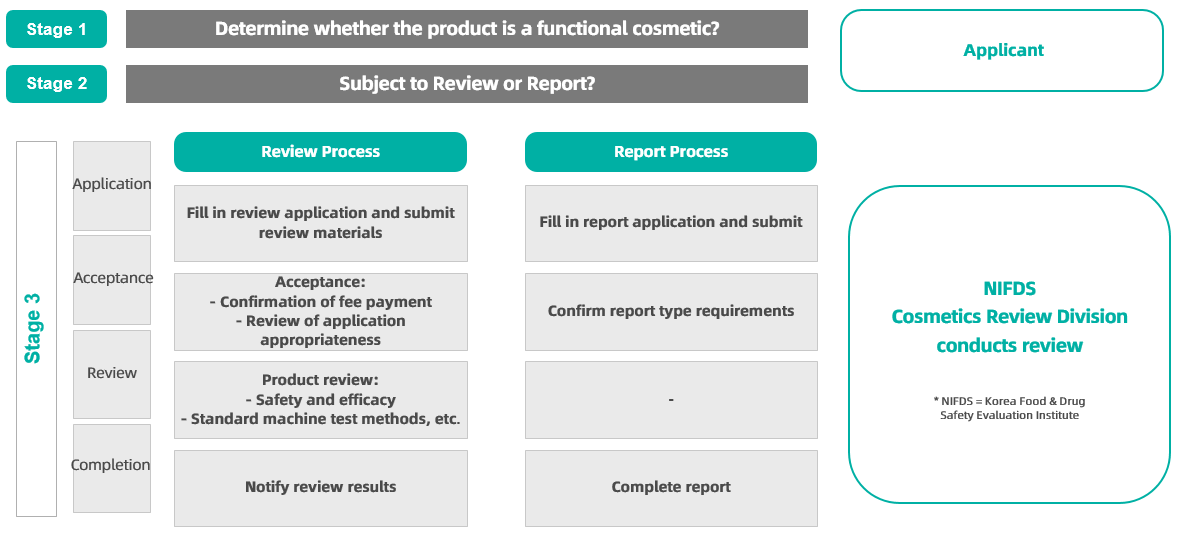
The registration process for functional cosmetics notification is as follows:
Why Choose CIRS?
CIRS Group is a product safety and regulatory compliance consulting firm with over 20 years of experience in cross-border cosmetic compliance between China and South Korea.
Bilingual & Trilingual Experts: Technical teams operating in Chinese, Korean, and English eliminate language barriers and regulatory misinterpretations.
End-to-End Execution: Complete coverage across the chain—from factory assessment, Responsible Seller setup, and product filings to testing, customs guidance, and post-market CAPA management.
In-Country Technical Presence: CIRS operates a wholly-owned subsidiary in South Korea. Its senior local consultants have 5–10 years of experience and maintain direct communication with the MFDS, KPTA, and KCID committees.
Rapid Turnaround Times: Standard compliance projects are completed within 1 to 3 months.
Top-Tier Toxicologists & Scientists: Our technical team covers 24 Chinese certified toxicologists (DCST), 2 US certified toxicologists (DABT) and 1 European registered toxicologist (ERT).
Frequently Asked Questions for Industry
Q: Do general color cosmetics need to be registered in South Korea?
A: Yes. All imported finished cosmetic products must be registered under a licensed South Korean Responsible Seller. While general color cosmetics do not require pre-market approval, they still require pre-clearance filing.
Q: Is it available to use standard English INCI names on the product packaging?
A: No. South Korea requires standard Korean ICID nomenclature. Mismatches between INCI names and Korean ICID entries are a primary cause of registration delays.
Q: Is foundation with SPF/PA classified as a functional cosmetic?
A: Yes. Any product bearing sun protection, whitening, or anti-wrinkle claims is regulated as a functional cosmetic and requires pre-market review by the MFDS (taking 2–4 months on average).
Q: What if our manufacturing facility in China lacks ISO 22716 certification?
A: The MFDS enforces strict GMP standards. Facilities without ISO 22716 must supply comprehensive SOPs and quality management records for evaluation. English documentation should be prepared in advance.
Q: What documents are required for customs clearance?
A: Commercial Invoice, Packing List, Certificate of Origin (if utilizing FTA benefits), Formulation Breakdown, and COA. Ingredient names must match the Korean ICID labels exactly, and weights/quantities must align precisely across all shipping documents.
Warm Reminds
CIRS warmly reminds that enterprises should pay attention to the following aspects before exporting their products to South Korea:
- Formula Pre-Audit: Review ingredients against Korean regulations prior to mass production to avoid costly reformulations.
- Pre-Shipment Labeling: Apply compliant Korean labels before shipping to avoid high costs and delays associated with bonded warehouse labeling.
- Claim Validation: Ensure all packaging and promotional claims match approved filing scopes exactly.
- Standardized Nomenclature: Maintain a master cross-reference table for Chinese, English (INCI), and Korean (ICID) ingredient names across all compliance records.
- Retention Samples: Store production retention samples for each batch through the expiration period (sufficient for at least two full analytical re-tests).
- Change Management: Provide at least 3 months' advance written notice to your Korean partner prior to changing raw material suppliers or manufacturing processes.
- Product Liability Insurance: Secure PL insurance to mitigate financial exposure and ensure clear precaution statements are printed on packaging.