
Technical Summary Based on the Latest OECD Guideline No. 497
The OECD Test Guideline 497, released on July 2, 2026, introduced the SARA-ICE tool, elevating the assessment of skin sensitization from a qualitative classification of relevance to a quantitative evaluation of skin sensitization potency.
The SARA-ICE method is a Bayesian statistical model developed by the NTP Interagency Center for the Evaluation of Alternative Toxicological Methods (NICEATM) in collaboration with Unilever, designed to estimate a human-relevant skin sensitization potency indicator. This indicator, known as ED01, represents the estimated skin dose (μg·cm⁻²) at which the probability of skin sensitization is 1% in the Human Patch Test (HPPT).
SARA-ICE leverages NICEATM's integrated database of over 400 chemical substances, encompassing in vivo data (Human Patch Test HPPT, Local Lymph Node Assay LLNA) and in vitro data (DPRA, h-CLAT, U-SENS, and other methods), to predict the Point of Departure (PoD). Following the adoption of the latest OECD 497 method, it is now possible not only to determine whether a substance "can cause skin sensitization," but also, given sufficient data, to answer "at what dose level it may induce a low-incidence sensitization response in the human population."
Within this technical framework, the SARA-ICE method utilizes in vitro data from multiple Key Events (KE), combined with the integration of existing animal or human historical data, to generate probabilistic inferences of the population sensitization dose within a Bayesian statistical framework. The primary model output is the ED01 distribution, while the final result used for regulatory and risk assessment purposes is the PoD. Therefore, the PoD under SARA-ICE is not a directly calculated single value, but rather a modeled process in which the ED01 distribution is first generated and the PoD is then extracted according to guideline specifications. The resulting PoD is directly dependent on the applicability, quality, and coverage of Key Events in the input data.
According to the relevant requirements of OECD TG 497, the application of SARA-ICE requires data from at least two different Key Events (KE), such as test data from OECD 442C, 442D, or 442E. Generally, the more comprehensive the data sources and the higher the consistency between different Key Events, the more stable the model output.
In terms of input information, the following categories of content should be prepared at a minimum:
Summary of Acceptable Test Methods for SARA-ICE
Test Method | Test Guideline | Key Molecular Event | Data Input |
DPRA | TG 442C | 1 | Depletion percentage (Cysteine and Lysine) |
kDPRA | TG 442C | 1 | log kmax (unit M⁻¹·s⁻¹) |
KeratinoSens | TG 442D | 2 | EC1.5 and IC50 (µM) |
h-CLAT | TG 442E | 3 | EC200(CD54), EC150(CD86), CV75 (µg·mL⁻¹) |
U-SENS | TG 442E | 3 | EC150 and CV70 (µg·mL⁻¹) |
LLNA | TG 429, TG 442A, TG 442B | 4 | EC3 (%) |
HPPT | N/A | Adverse Outcome | Skin dose (µg·cm⁻², number of subjects N, number of sensitized subjects N) |
Additionally, to facilitate the review of analysis results and report generation, substance identification information such as chemical name and CAS number is also required.
SARA-ICE Data Input and Results Review Workflow
The workflow follows the sequence: "Upload Input Data → Select Calculation Model → View Prediction Results → Generate Report." Report generation is not covered in this demonstration.
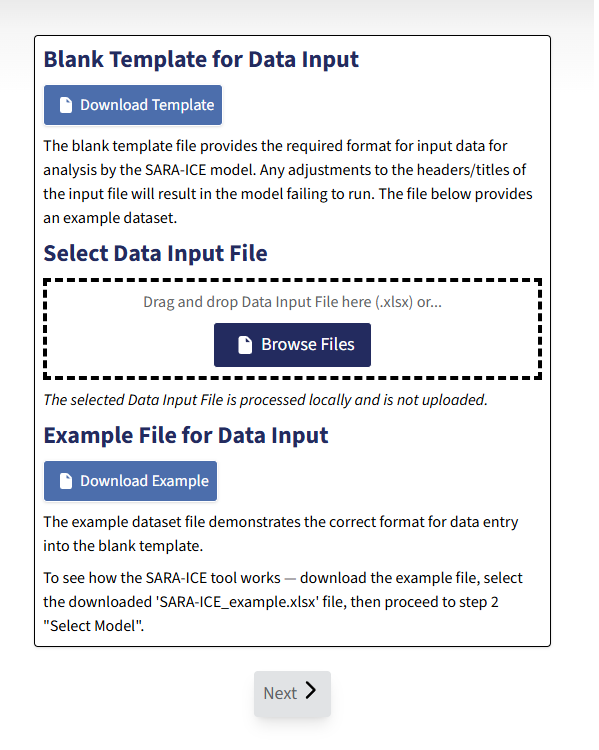
1. Upload Input Data
First, download the standard template, fill in the chemical information and test data according to the field requirements, and upload the local input file. This step corresponds to data preparation and import, which directly affects the results of subsequent model runs.
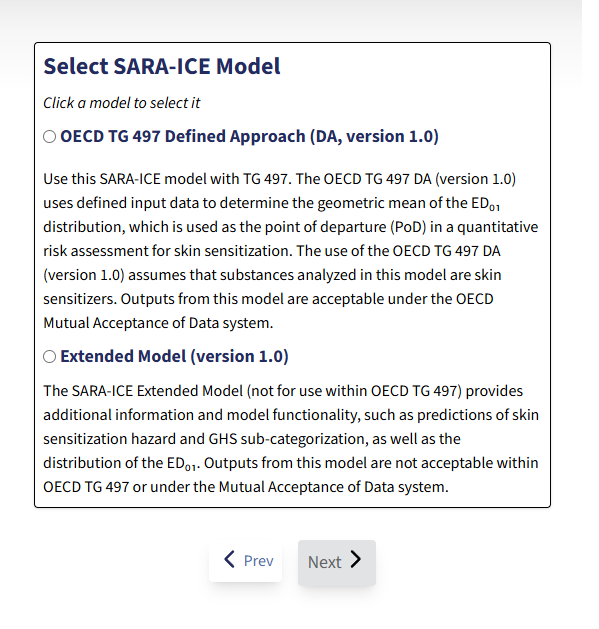
2. Select Calculation Model
In the model selection interface, choose either the OECD TG 497 Defined Approach or the Extended Model based on the assessment purpose. The model selection determines the focus of subsequent outputs, whether it is biased toward PoD derivation or considers both hazard and GHS sub-categorization.
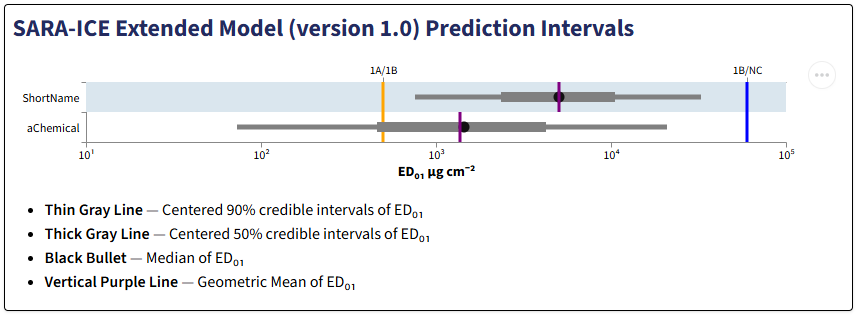
3. View Prediction Results
After the calculation is complete, you can review output content such as classification result tables, key quantiles, and prediction interval plots.
4. Generate reports as needed for various regulatory purposes.
In summary, the SARA-ICE method based on OECD 497 derives a quantitative PoD through modeling, building upon previously completed qualitative classification of skin sensitization. This represents the milestone update of the OECD 497 method.
About CIRS
Established in 2007, the CIRS Group is a leading product safety and regulatory consulting firm. CIRS has branch offices in the Republic of Ireland, South Korea, the United States, the United Kingdom, Japan and China. CIRS Group utilizes its technical expertise, various resources, and international network to provide one-stop compliance services from regulatory compliance, laboratory testing, R&D to data services across multiple industries. This includes chemicals, cosmetics, food and food beverages, medical devices, agrochemical products, disinfectants, and consumer goods. It helps clients gain a competitive advantage by reducing business risks associated with regulatory affairs.
The CIRS cosmetic team provides expert support to ensure that cosmetic products meet stringent global cosmetic regulations and safety standards.
We offer comprehensive, lifecycle-based solutions for personal care products, from early-stage cosmetic ingredient development through to final product registration. Our services include:
- Cosmetic ingredient development and regulatory strategy,
- Physical/chemical and analytical tests,
- Toxicological tests (in vivo & in vitro),
- Efficacy and claim substantiation studies (in vivo & in vitro), and
- Ingredient and product registration across global markets.
With deep expertise in cosmetic regulatory compliance and safety evaluations, our team enables brands to bring products to market efficiently and with confidence.
Our Services
- Cosmetics Safety Test
- Cosmetics Efficacy Claims Test
- Micrological analysis
- Physicochemical Analysis
- Skin Sensitization QSAR Toolbox Model Prediction (OECD 497)
If you need any assistance or have any questions, please get in touch with us via service@cirs-group.com.